
Our Practice
About Aikido
Aikido is a Japanese martial art of throws, joint locks, and pins, practiced cooperatively rather than competitively.
Tradition
A Martial Art of Harmony
Aikido uses throws, joint locks, pins, and evasive movement to redirect an attack. Like Judo, it includes learning how to throw and fall safely, though the techniques and training methods differ. Students practice with partners to develop balance, timing, posture, and control.
Unlike competitive martial arts, traditional Aikido is not organized around winning matches or tournaments. Partners cooperate: one offers an attack and receives a technique, then they exchange roles. At Framingham Aikikai, this physical practice is also a path of personal growth, welcoming beginners, families, and dedicated long-term students.
Morihei Ueshiba and the Origins of Aikido
Aikido was developed in Japan by Morihei Ueshiba (1883–1969), known to practitioners as O-Sensei. Drawing on years of martial training, especially in jujutsu, Ueshiba came to understand martial practice as more than a way to defeat an opponent.
In 1924, Ueshiba was captured with a group traveling in Mongolia and narrowly escaped execution. He later described a profound spiritual awakening in Japan in 1925, an experience that helped shape his vision of martial arts as a way to cultivate harmony rather than simply overpower others. These were separate events, and the spiritual experience is part of Ueshiba’s own account of his life.
Training
What Students Learn
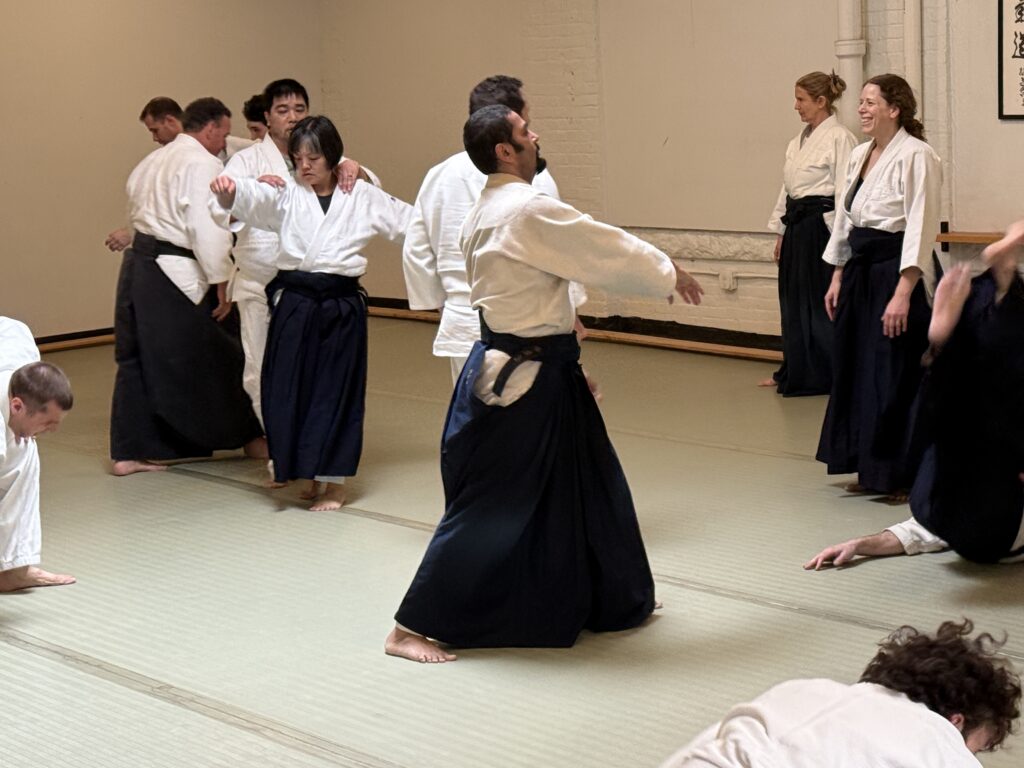
Training includes learning to apply throws and joint locks with care, to receive techniques safely through ukemi (falling and rolling), and to improve coordination through repeated partner practice. Classes emphasize steady progress, attentive training, and mutual care.
Centered movement
Respectful etiquette
Ukemi and safety
Calm under pressure
Philosophy
The Art of Peace
The spirit of Aikido is not rooted in aggression. Its purpose is to cultivate awareness, self-control, and the ability to respond to challenge without unnecessary harm.
In Aikido, students do not learn to overpower someone by wrestling strength against strength. Instead, they learn to blend with incoming movement, redirect force, and stay connected to their partner.
Both people cooperate in practice: one initiates an attack, and the other practices a response using a throw, lock, or pin. Then they switch roles. Students learn both to apply techniques and to receive them safely, building trust, humility, and care.
The goal is not to defeat another person, but to practice meeting conflict with calm, balance, and reconciliation.
Students practice blending, redirection, and disciplined movement through partner training. Over time, this practice can strengthen confidence, posture, focus, and resilience both on and off the mat.
Harmony does not mean just getting along with people on the lowest common denominator, or creating agreement without regard to rules in order to avoid confrontation and maintain an easy going or overly comfortable environment. Harmony, as used in aikido, does not involve compromising, diminishing, or diluting opposing things and their individual essences… Rather Aikido’s Harmony brings different, -even opposing- elements together and intensifies them in a way that drives everything toward a higher level.
Mitsunari Kanai Shihan, 8th dan (1939-2004)
Whether someone begins through an intro program or continues through years of study, Aikido offers a lifelong path of learning grounded in tradition, humility, and community.
Sign up for your free class
Who will be training?